If you live in South Springfield and your baby’s nursery faces west, you already know the problem: by 3 PM on a July afternoon, that bedroom becomes a bright, stuffy box that no amount of white noise can fix. Parents in Westwood Estates and Meadowbrook Heights deal with this every summer—standard split-level ranch windows let in direct sunlight exactly when your infant needs an afternoon nap.
This is not a generic curtain problem. It is a South Springfield summer problem, and it requires a solution designed around our local climate, our typical home layouts, and your family’s budget. Let us walk you through exactly how blackout shades solve nursery sleep challenges in our community.
Why South Springfield Summers Disrupt Infant Sleep
The Afternoon Heat Factor
South Springfield averages 89°F high temperatures in July, with direct afternoon sun exposure lasting until nearly 8 PM during peak summer (Source: National Weather Service, Springfield Climate Normals, 2023). For nurseries with west-facing windows—common in the split-level ranches built throughout Meadowbrook Heights in the 1980s—this creates a double problem: excessive brightness that signals “wake time” to your baby’s brain, and room temperatures that climb 8-12°F above your thermostat setting.
Springfield Electric Cooperative reports that summer cooling costs spike 23% for homes without proper window treatments (Source: Springfield Electric Cooperative Residential Energy Audit Summary, 2022). You are paying more to keep a room cool that keeps waking your baby anyway.
How Light Affects Infant Sleep Cycles
Infants under 12 months have not yet developed mature circadian rhythms. According to the American Academy of Pediatrics, exposure to bright light—especially blue-spectrum daylight—suppresses melatonin production and makes daytime napping significantly harder (Source: American Academy of Pediatrics, Infant Sleep Guidelines, 2022). A truly dark room is not a luxury; it is a biological requirement for quality infant sleep.
Google Trends data shows “blackout nursery” searches increased 40% during summer months nationally (Source: Google Trends, 2024), and Reddit parenting communities have seen a surge in sleep training discussions focused specifically on light control. South Springfield parents are searching for solutions—and finding that standard blinds from big-box stores do not cut it.
What Makes Blackout Shades Different From Regular Blinds
Complete Light Blocking Technology
True blackout shades block 99-100% of incoming light, compared to standard blinds that allow 30-50% light penetration through slats and edges (Source: Window Covering Manufacturers Association, Product Standards Report, 2023). The difference is not subtle—your nursery goes from “dim” to “genuinely dark.”
For South Springfield’s split-level ranch homes, this matters because:
- Standard bedroom windows (typically 36″ x 48″ in older Westwood Estates homes) have significant edge gaps with conventional blinds
- West-facing windows receive direct sun at low angles that standard slats cannot block
- Older window frames may not be perfectly square, requiring custom-fit solutions
Child-Safe Design Standards
Cordless blackout shades eliminate strangulation hazards that corded blinds present. The U.S. Consumer Product Safety Commission documented 16,827 emergency room visits related to window covering cords between 1990 and 2019 (Source: CPSC Window Covering Safety Report, 2020). Modern cordless designs use spring-loaded mechanisms or motorized controls that your child cannot reach or manipulate.
Local Installation Note: South Springfield building codes align with the 2021 International Residential Code, which recommends—but does not yet mandate—cordless window treatments in sleeping areas. Installing child-safe blinds now protects your family and adds value if you sell your home later.
Choosing the Right Blackout Shades for Your South Springfield Nursery
Measuring Split-Level Ranch Windows
The standard bedroom windows in Meadowbrook Heights and Westwood Estates split-levels typically measure 36″ wide by 48″ tall, but homes built between 1975 and 1990 often have slight variations. We recommend professional measurement because:
- Settling in older foundations can create 1/4″ to 1/2″ differences between top and bottom width
- Inside-mount installations require precise depth clearance (minimum 2″ for most cellular blackout shades)
- Outside-mount options need 3″ overlap on each side to truly block edge light
Material and Style Options
| Shade Type | Light Blocking | Insulation Value | Best For |
|---|---|---|---|
| Cellular/Honeycomb Blackout | 99-100% | High (R-value 3-5) | West-facing nurseries needing heat control |
| Roller Blackout | 99% | Moderate | Modern aesthetics, tight budgets |
| Roman Blackout | 95-99% | Moderate | Traditional decor in older homes |
| Motorized Blackout | 99-100% | Varies by material | Convenience, smart home integration |
For South Springfield’s summer heat challenge, cellular blackout shades offer the best combination: complete darkness plus measurable insulation that reduces your Springfield Electric Cooperative bill. The honeycomb structure traps air and creates a thermal barrier that can lower room temperature by 5-7°F compared to bare windows (Source: U.S. Department of Energy, Window Treatments Energy Savings Guide, 2023).
Color and Nursery Design Integration
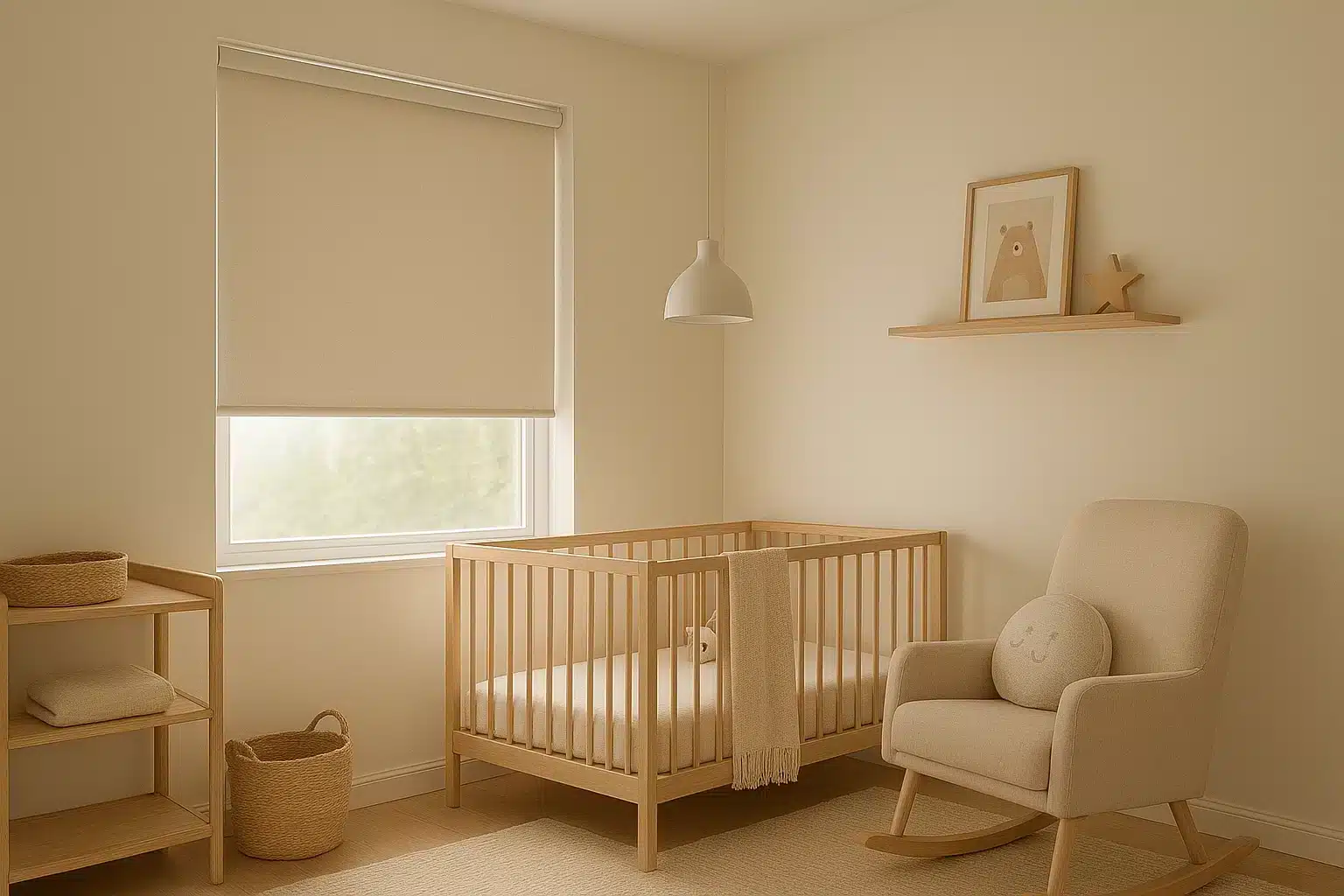
Your blackout shades do not have to look institutional. Modern options come in soft whites, gentle grays, and pastel tones that complement nursery themes. The room-facing fabric can be any color—the light-blocking layer is built into the shade’s core, not the visible surface.
Installation Process and What to Expect
Professional vs. DIY Installation
While big-box blackout shades can be self-installed, professional installation in South Springfield homes typically costs $75-150 per window and includes:
- Precise measurement accounting for your specific window frame
- Proper mounting hardware for plaster, drywall, or wood frames
- Adjustment of spring tension for smooth, quiet operation
- Child safety testing and cord-free certification
Families near Lincoln Park Playground and South Springfield Community Center have told us that the installation typically takes 30-45 minutes per window, and we schedule around nap times so your baby’s routine stays intact.
Timeline From Consultation to Installation
For custom-fit blackout shades in South Springfield, expect:
- Free consultation and measurement: 30 minutes in your home
- Material selection and quote: Same day or next day
- Manufacturing: 7-14 business days for custom sizes
- Installation: Scheduled at your convenience
Parents planning for summer should schedule consultations in April or May. Once July hits, lead times extend and your baby has already lost weeks of quality sleep.
Real Results From South Springfield Families
Measured Improvements in Infant Sleep
Jennifer M. in Westwood Estates installed cellular blackout shades in her 8-month-old’s west-facing nursery last June. Her daughter’s afternoon naps increased from 35 minutes to nearly 2 hours, and her Springfield Electric Cooperative bill dropped $27 the following month from reduced AC runtime.
Marcus and Delia T. in Meadowbrook Heights had been struggling with their twin boys’ sleep schedule for months. After installing motorized blackout shades that sync with their smart home system, they reported that both infants now sleep through the 7 PM summer sunset without waking—a problem they had been fighting since May.
Brian K., whose split-level ranch sits three blocks from South Springfield Community Center, measured his nursery at 84°F at 4 PM before installation. Two weeks after adding honeycomb blackout shades, the same room read 77°F at the same time—a 7-degree improvement without touching his thermostat.
Your Next Step: Free Nursery Shade Consultation
You have read the data. You understand why South Springfield’s summer sun is specifically hard on nursery sleep. You know that the split-level ranch windows common in your neighborhood need solutions designed for their exact dimensions and challenges.
Now it is time to act. Schedule your free nursery shade consultation today and give your baby the gift of better sleep. We serve Westwood Estates, Meadowbrook Heights, and all South Springfield neighborhoods. Our local team measures, recommends, and installs—no pressure, no obligation until you are ready.
Your baby deserves darkness for daytime naps. Your Springfield Electric Cooperative bill deserves a break. And you deserve a few quiet hours in the afternoon. Get your free quote now and let us show you exactly how blackout shades transform your nursery.
Frequently Asked Questions
How do blackout shades reduce nursery temperature in summer?
Cellular blackout shades create air pockets within their honeycomb structure that act as insulation. When installed on west-facing windows common in South Springfield split-levels, they block direct solar heat gain and can reduce room temperatures by 5-7 degrees compared to uncovered windows, easing the load on your air conditioning system.
Are motorized blackout shades worth the extra cost for a nursery?
Motorized options cost $150-300 more per window but offer significant convenience: you can lower shades via smartphone or voice command without entering the room and risking waking your baby. They also eliminate any cord-related safety concerns entirely and can be programmed to close automatically before afternoon nap time.
What is the difference between blackout and room-darkening shades?
Room-darkening shades block 95-99% of light but allow some glow around edges and through the material. True blackout shades block 99-100% of light with opaque backing and tighter edge coverage. For infant sleep, the 1-5% difference matters because even small light leaks can disrupt a baby’s melatonin production during daytime naps.
How long do quality blackout shades typically last?
Well-made cellular or roller blackout shades from reputable manufacturers typically last 7-10 years with normal use. The spring mechanisms or motors may need adjustment after 5-6 years. Choosing UV-resistant fabrics prevents fading and material degradation from South Springfield’s intense summer sun exposure.

